The primary internal support establishes the axis and carries the vertical form.
PROJECT 11 / ART / SCULPTURE
EXPLORING FORM 01
A hands-on study of volume, balance and silhouette built before my transition into digital 3D. Clay, found structure, paint and resin became a way to understand form physically before constructing it inside a virtual space.
VIEW BUILD PROCESS01 / PREMISE
Understand form before simulating it.
Exploring Form 01 began as a physical exercise rather than a digital one. Before getting deeper into 3D modeling, I wanted to work directly with mass, weight, proportion and surface using my hands. Clay forces those decisions to become immediate. A shape has to stand, balance, transition and occupy real space before it can become aesthetically convincing.
The sculpture became a precursor to later digital work because it strengthened an understanding that software can sometimes hide: form is not only an outline. It is volume, support, negative space, gravity, texture and the relationship between one plane and the next. Building those relationships physically created a stronger foundation for approaching form later in 3D.
02 / STRUCTURE
Give the mass something to become.
The sculpture began with a simple internal support system. A metal pipe established the vertical base while a tightly packed bag filled with newspaper created initial volume without requiring the entire form to be solid clay. That rough structure defined the first limits of the object before the surface began to take shape.
It was a practical construction choice, but it also introduced an important design lesson: finished form depends on unseen structure. The external silhouette can feel organic and expressive while still relying on an internal system that carries weight, establishes scale and gives the material something stable to build around.
01 / 04
STRUCTURE 01
BASE / SUPPORT
A metal pipe establishes the main support and gives the sculpture a stable axis before any finished surface exists.
03 / BUILDING FORM
Build volume one decision at a time.
Clay was added progressively around the underlying structure and shaped with sculpting tools. Rather than starting with a perfectly defined final object, the form emerged through adjustment: adding mass, removing it, tightening contours and studying how one section transitioned into another.
That process made proportion tangible. Every change affected the whole object. A wider section changed the perceived weight above it. A sharper transition altered the silhouette. Working this way created an instinctive understanding of how continuous surfaces carry visual information across a three-dimensional form.
SCULPTURE / BUILD
▶
ENTER
04 / SURFACE + FINISH
SURFACE / FINISH
↗
ENTER
Lock the form, then change how it reads.
Once the clay form was resolved, paint introduced a second layer of authorship. Color and surface treatment could emphasize or soften the underlying geometry, changing the way the same mass was perceived without changing its physical shape.
Resin was then used to secure and finish the object. The final surface transformed the sculpture from an active clay study into a more stable artifact, preserving the physical decisions made during the build and preparing it to be presented as a completed piece rather than an unfinished exercise.
05 / MATERIAL SYSTEM
A simple material stack supporting a complex form.
The construction is deliberately low-tech. The project does not depend on specialized fabrication equipment. Its value comes from understanding what each material is doing: support, bulk, shape, surface and protection.
That separation maps surprisingly well to later digital workflows. A 3D object may eventually be divided into mesh, topology, material, texture and rendering, but the underlying design problem is similar. Different layers contribute different properties while the viewer experiences them as one resolved form.
A tightly packed newspaper-filled bag creates bulk efficiently beneath the sculpted surface.
The primary modeling material used to establish volume, contour, transitions and silhouette.
Used to add, remove, compress and refine material as the form develops.
Color changes how the underlying form is read and establishes the final visual character.
Secures and preserves the finished sculpture while giving the object a resolved final surface.
06 / PROGRESSION
The object becomes visible gradually.
One of the strongest parts of the project is the record of the sculpture actually being built. The finished object is only the last frame. The progression reveals structure becoming mass, mass becoming recognizable form, and raw material becoming a finished artifact.
That progression also makes the learning visible. Each stage records a different type of problem: support, proportion, surface, refinement and finish. Rather than presenting form as something that appears fully resolved, the process shows it as something discovered through repeated physical decisions.
PROGRESSION 01
ARMATURE
THE INTERNAL AXISThe first stage establishes the support system: a metal pipe and lightweight packed volume create the hidden structure the sculpture will grow around.
07 / PRESENTATION
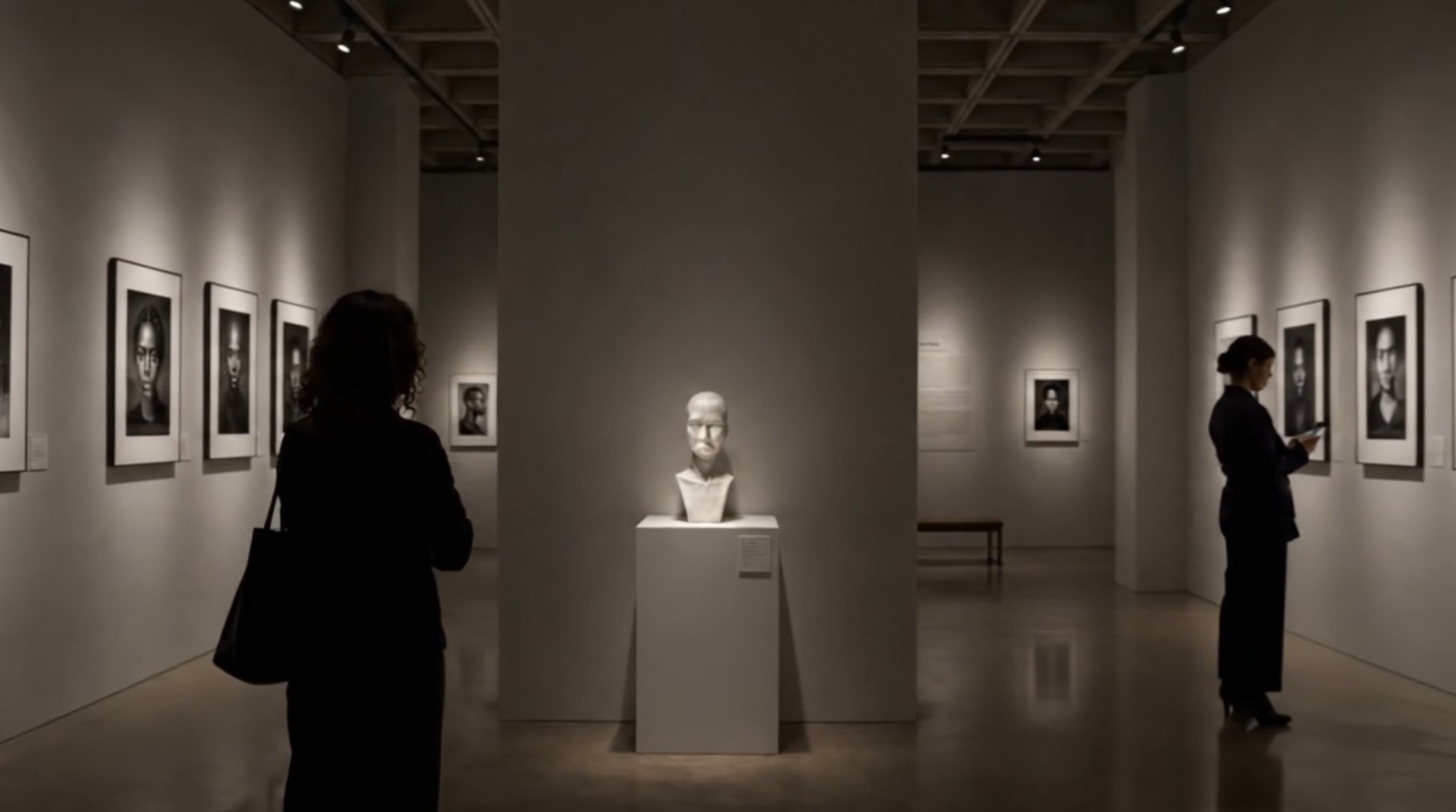
Move the object from workspace to exhibition space.
The final sculpture is also shown in a museum context. That presentation changes the scale at which the piece is read. The object is no longer surrounded by tools, materials and process; it is isolated, lit and treated as a finished work.
Showing both contexts is useful because they complete each other. The build sequence explains how the form was made, while the museum presentation asks whether the final object can stand on its own once the evidence of construction disappears.
MUSEUM / PRESENTATION
↗
ENTER
08 / BRIDGE TO 3D
Physical intuition became digital vocabulary.
Exploring Form 01 sits before my deeper work in 3D modeling, but that is exactly why it belongs in the larger body of work. It documents the point where form was being understood physically: by touching material, seeing weight from multiple angles and discovering how an object changes as volume is added or removed.
Later digital tools made iteration faster and opened much larger spatial possibilities, but the questions remained familiar. What is carrying the form? Where does the eye travel? How does one surface become another? What does the silhouette communicate from across the room? The software changed. The study of form did not.